
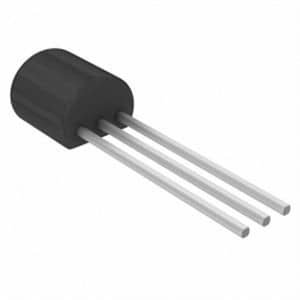
Description
BC556 Transistor (PNP, 80V, 0.1A)
The BC556 is a PNP (Positive-Negative-Positive) bipolar junction transistor (BJT) commonly used for low-power amplification and switching applications in electronic circuits. It is a general-purpose transistor, often found in signal amplification, switching, and small-signal applications.
Key Features:
- Type:
- PNP: This means the BC556 is a PNP transistor, which allows current to flow from the emitter to the collector when a negative voltage is applied to the base.
- Maximum Collector-Emitter Voltage (Vce):
- The BC556 has a maximum collector-emitter voltage of 80V, meaning it can withstand voltages up to 80V between the collector and emitter without breakdown.
- Maximum Collector Current (Ic):
- It can handle a maximum collector current of 0.1A (100mA), making it suitable for low-power applications but not suitable for high-current circuits.
- Power Dissipation:
- The transistor has a maximum power dissipation of 500mW (0.5W), meaning it can safely dissipate up to half a watt of power without overheating.
- Transition Frequency (fT):
- The transition frequency or cutoff frequency is around 250 MHz, which indicates its performance in high-frequency switching and amplification. This makes it suitable for medium to low-frequency signal applications.
- Package:
- The BC556 typically comes in a TO-92 package, which is a through-hole type package that allows for easy insertion into a circuit board.
- Current Gain (hFE):
- The current gain (hFE) of the BC556 ranges from 110 to 800, indicating the ratio of output current to input current, meaning it can amplify weak signals.
Applications:
- Switching:
- The BC556 is commonly used in low-power switching circuits, where it can turn on or off other components based on a small input signal.
- Amplification:
- It is used in audio and signal amplification circuits to boost weak analog signals, such as in pre-amplifier stages of audio systems or as part of audio mixing equipment.
- Voltage Regulation:
- The BC556 is used in voltage regulation circuits, where it helps maintain a constant voltage by controlling current flow through the circuit.
- Signal Processing:
- Due to its low current handling capacity, the BC556 is used in signal processing circuits for low to medium frequency applications.
- Inverter and Oscillator Circuits:
- It can be used in inverter or oscillator circuits that require moderate switching and amplification capabilities, typically in low-voltage systems.
- Analog Circuits:
- It is used in analog circuits for biasing, signal conditioning, and feedback control to manage small analog signals.
Advantages:
- Low Power Consumption:
- The BC556 is ideal for low-power applications, consuming very little power compared to larger transistors.
- Compact Size:
- With its TO-92 package, the BC556 is a small and compact component, making it ideal for designs with limited space.
- Ease of Use:
- As a general-purpose transistor, it is easy to integrate into a variety of circuits and is widely available for use in both amplification and switching applications.
- Stable Performance:
- The BC556 provides stable performance in low-power applications, with good linearity in amplification circuits.
- Availability:
- This transistor is widely available in most electronics stores and online, making it a cost-effective and easy-to-source component for hobbyists and professionals alike.
Disadvantages:
- Low Current Rating:
- With a maximum current rating of 100mA, the BC556 is unsuitable for high-power applications where higher current is required.
- Limited Voltage Rating:
- The maximum voltage rating of 80V may be restrictive in certain applications, particularly those involving higher voltages.
- Not Suitable for High-Frequency Applications:
- While it can handle medium-frequency applications, the BC556 may not be suitable for very high-frequency applications due to its limited transition frequency (250 MHz).
How to Use:
- Wiring:
- Emitter (E): Connect the emitter to the negative side of the circuit.
- Collector (C): Connect the collector to the load or the negative side of the power supply.
- Base (B): Apply a small negative voltage (relative to the emitter) to the base to switch the transistor on, allowing current to flow from the emitter to the collector.
- Biasing:
- Proper biasing is crucial to ensure that the BC556 operates in its active region. Typically, you would need to provide a resistor between the base and the input signal to control the base current.
- Heat Dissipation:
- If the transistor is dissipating significant power (near its maximum rating), ensure that adequate heat sinking is provided to avoid overheating and failure.
Reviews
There are no reviews yet.